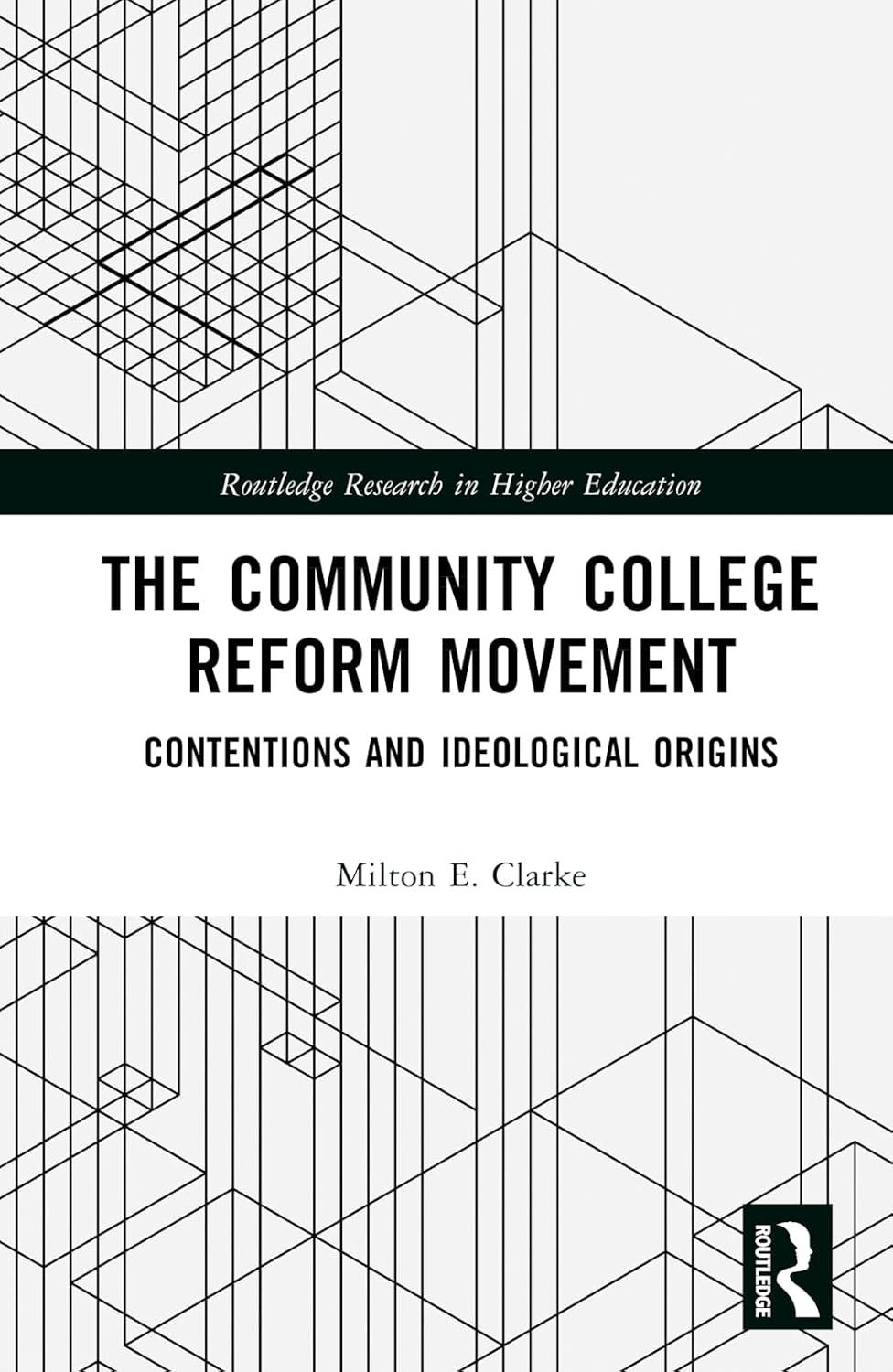
THE COMMUNITY COLLEGE
REFORM MOVEMENT
Contentions and Ideological Origins
Milton E. Clarke
Purchase Here!
In Hardcover, Paperback, and eBook






Our Partners
Our Partners














Book Summary
In this book, Milton E. Clarke critically examines the rise of the higher education reform movement, often referred to as the "completion agenda," which, since the early 2000s, has sought to restructure core aspects of the community college experience. Using community colleges from across nine U.S. states as practical examples, it explores the major higher education reforms, including dual enrollment, the demise of developmental education, corequisites, and performance-based funding.
Against the popular view that support for such policies is tied to neoliberalism, it argues for a more nuanced understanding of the complicated and often indistinct ideological foundation of the reform movement, demonstrating that supporters and detractors alike draw on similar concepts such as equity, student success, and affordability. This complication is further clarified through an account of the history, processes, functions, and institutions that paved the way for the advent of the higher education reform movement.
This book is vital reading for anyone interested in the future of community colleges and higher education. A special resonance is expected with scholars, researchers, and educators involved in higher education, educational reform, and educational policy.
In this book, Milton E. Clarke critically examines the rise of the higher education reform movement, often referred to as the "completion agenda," which, since the early 2000s, has sought to restructure core aspects of the community college experience. Using community colleges from across nine U.S. states as practical examples, it explores the major higher education reforms, including dual enrollment, the demise of developmental education, corequisites, and performance-based funding. Against the popular view that support for such policies is tied to neoliberalism, it argues for a more nuanced understanding of the complicated and often indistinct ideological foundation of the reform movement, demonstrating that supporters and detractors alike draw on similar concepts such as equity, student success, and affordability. This complication is further clarified through an account of the history, processes, functions, and institutions that paved the way for the advent of the higher education reform movement. This book is vital reading for anyone interested in the future of community colleges and higher education. A special resonance is expected with scholars, researchers, and educators involved in higher education, educational reform, and educational policy.
Podcasts
The Author
Milton E. Clarke is a recently retired community college instructor who taught political science for over 30 years. In addition to numerous articles on various subjects, he has written extensively about California politics. Milton played an active role in campus affairs, including such activities as student club advisor, shared governance, grants writing, project management, and collective bargaining.
Podcasts
For reviewers who represent a media organization or are able to publish a review in a media organization, an examination copy of The Community College Reform Movement: Contentions and Ideological Origins may be available through the completion of a Routledge/Taylor and Francis “Media Review Request Form,” which is available below: